

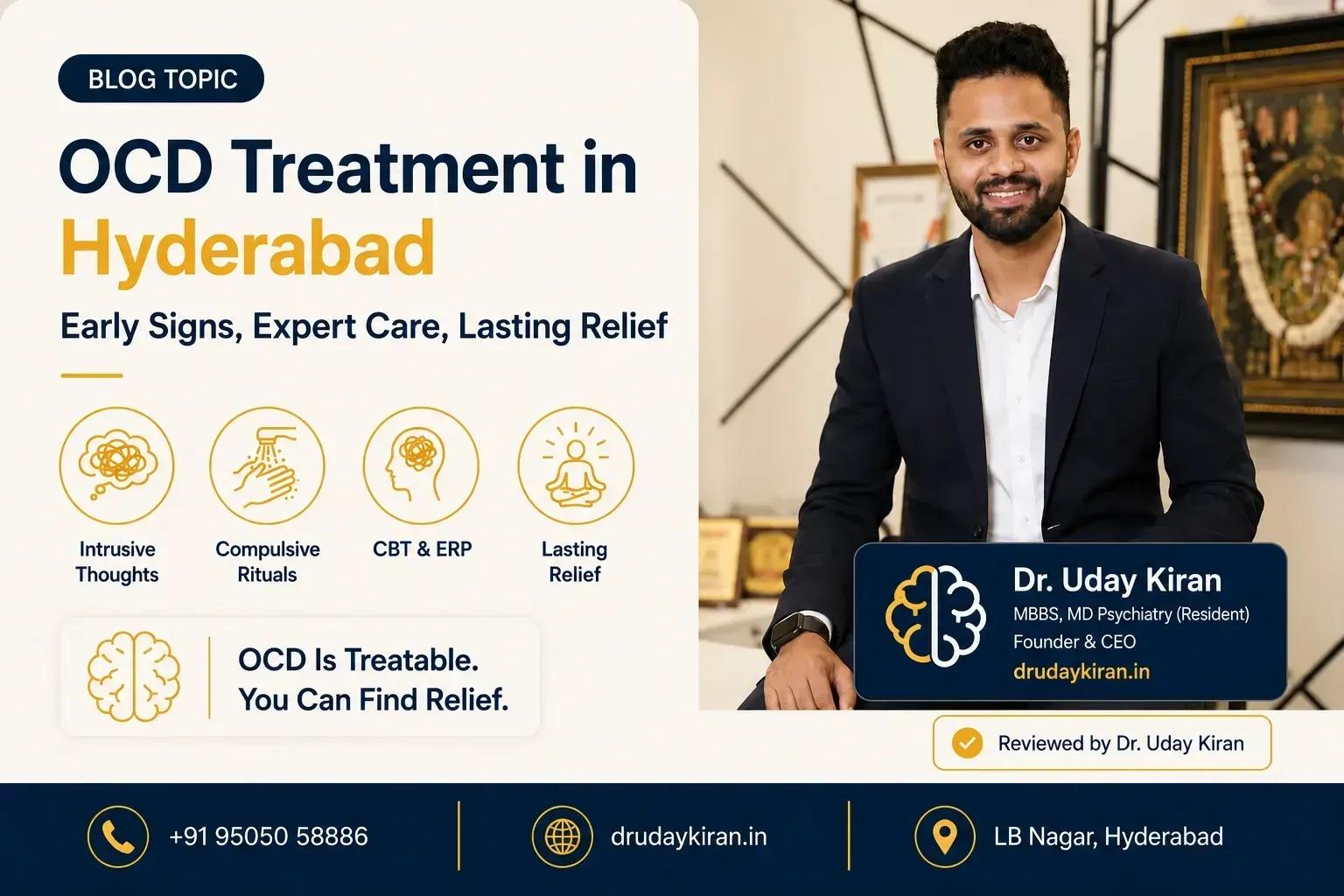
Obsessive-Compulsive Disorder (OCD) is often trivialized in everyday conversation — people casually say they're "a little OCD" about keeping their desk tidy or organizing their bookshelf by color. But clinical OCD is a serious, often debilitating psychiatric condition, involving intrusive, unwanted thoughts and repetitive behaviors that can consume hours of a person's day and significantly interfere with their ability to function. Because the symptoms can sometimes be subtle, embarrassing, or misunderstood, many people delay seeking help for months or even years. Understanding the specific warning signs that shouldn't be ignored — and knowing when to seek professional OCD Treatment in Hyderabad — can make a meaningful difference in how quickly someone finds relief.
Dr. Uday Kiran, CEO of Bharosa Neuro Psychiatry Hospitals, has treated a wide range of OCD presentations over the years and offers expert insight into the symptoms that most often go unrecognized or dismissed.
Understanding Obsessions and Compulsions
OCD is built around two core components: obsessions, which are intrusive, unwanted thoughts, images, or urges that cause significant anxiety or distress; and compulsions, which are repetitive behaviors or mental acts performed to reduce that anxiety or prevent a feared outcome. Importantly, compulsions provide only temporary relief, and over time, the cycle of obsession and compulsion tends to reinforce itself, making the anxiety feel even more urgent and the compulsive behavior feel even more necessary.
Recognizing this underlying pattern is essential for identifying when someone may benefit from professional OCD Treatment in Hyderabad, rather than dismissing their behavior as simply a quirky personality trait or an unusually strong preference for order.
Warning Sign #1: Excessive Time Spent on Rituals
One of the clearest indicators that OCD may be present is when rituals — whether checking, washing, counting, or arranging — begin consuming a significant portion of a person's day. Clinically, mental health professionals often use a general benchmark of an hour or more per day spent on obsessive thoughts or compulsive behaviors as a sign that the condition may warrant professional evaluation. If someone is repeatedly checking that the door is locked, washing their hands well beyond what's medically necessary, or spending excessive time arranging items until they feel "just right," this is a clear signal that professional OCD Treatment in Hyderabad may be needed.
Warning Sign #2: Distressing, Intrusive Thoughts
Many people with OCD experience intrusive thoughts that feel deeply disturbing or at odds with their actual values and character — thoughts about harming a loved one, blasphemous or taboo religious thoughts, or fears of having done something terrible without remembering it. These thoughts are often a source of intense shame, leading many individuals to hide them rather than seek help, fearing they will be judged or misunderstood.
It's important for both patients and families to understand that these intrusive thoughts are a hallmark symptom of OCD, not a reflection of the person's true desires or character. Recognizing this distinction is often a critical first step toward seeking appropriate OCD Treatment in Hyderabad, where these symptoms can be discussed and treated with clinical understanding rather than shame.
Warning Sign #3: Reassurance-Seeking Behavior
Many individuals with OCD repeatedly seek reassurance from friends, family members, or even medical professionals — asking the same questions over and over, seeking confirmation that they haven't made a mistake, or repeatedly researching symptoms online to rule out a feared illness. While occasional reassurance-seeking is normal, when this behavior becomes frequent, repetitive, and difficult to control, it often signals an underlying anxiety-driven pattern consistent with OCD.
Family members who find themselves constantly providing the same reassurance, sometimes multiple times a day, should consider this an important sign that professional OCD Treatment in Hyderabad may be beneficial — both for the individual and for reducing the burden reassurance-seeking places on relationships.
Warning Sign #4: Avoidance of Triggering Situations
Just as compulsions are used to reduce anxiety, avoidance is another common strategy people with OCD use to manage distress. This might involve avoiding public restrooms due to contamination fears, avoiding sharp objects due to intrusive harm-related thoughts, or avoiding social situations that might trigger uncomfortable obsessive thoughts. While avoidance may provide short-term relief, it often significantly narrows a person's world over time, limiting their ability to work, socialize, or engage fully in daily life.
When avoidance patterns begin significantly restricting someone's activities or opportunities, this is an important sign that seeking OCD Treatment in Hyderabad could help restore a fuller, less restricted life.
Warning Sign #5: Symmetry, Order, and "Just Right" Feelings
Not all OCD symptoms involve fear of harm or contamination. Some individuals experience intense discomfort when things aren't arranged symmetrically, evenly, or in a particular order, leading to repeated rearranging, counting, or repeating actions until they feel "just right." While this may seem less alarming than contamination fears, it can be equally distressing and time-consuming, and it responds to the same evidence-based treatments used for other forms of OCD.
Warning Sign #6: Significant Impact on Daily Functioning
Perhaps the clearest overall indicator that professional help is needed is when OCD symptoms — regardless of their specific form — begin to significantly interfere with work, relationships, or daily responsibilities. Missed deadlines due to excessive checking, relationship strain due to reassurance-seeking, or withdrawal from social activities due to avoidance are all signs that the condition has progressed to a point where professional OCD Treatment in Hyderabad is likely to provide meaningful benefit.
Why Early Recognition Matters
Like many psychiatric conditions, OCD tends to worsen without treatment, with obsessions and compulsions often becoming more frequent, more time-consuming, and more deeply entrenched over time. Recognizing the warning signs early — rather than dismissing them as personality quirks or waiting for symptoms to resolve on their own — allows for earlier, often more effective treatment.
At Bharosa Neuro Psychiatry Hospitals, Dr. Uday Kiran and his team provide comprehensive OCD Treatment in Hyderabad combining Cognitive Behavioural Therapy, particularly Exposure and Response Prevention (ERP), with medication management when appropriate, tailored to each patient's specific symptom pattern and severity.
What Effective Treatment Looks Like
Treatment typically begins with a thorough evaluation to understand the specific nature and severity of a patient's obsessions and compulsions, followed by a personalized treatment plan. For many patients, ERP therapy — which involves gradual, supported exposure to feared situations while resisting the urge to perform compulsions — forms the cornerstone of treatment, often combined with medication such as selective serotonin reuptake inhibitors (SSRIs) for more significant symptom relief.
Supporting Family Members Too
Because family members often become unintentionally involved in a patient's compulsions — through reassurance-seeking or accommodating avoidance behaviors — family education is an important part of comprehensive OCD Treatment in Hyderabad at Bharosa, helping loved ones understand how to support recovery without unintentionally reinforcing the disorder.
Reaching Out Sooner Rather Than Later
If you or someone you love has been experiencing any of these warning signs — excessive rituals, distressing intrusive thoughts, constant reassurance-seeking, avoidance, or a need for symmetry and order — it's worth taking these symptoms seriously rather than dismissing them. Dr. Uday Kiran and the team at Bharosa Neuro Psychiatry Hospitals provide compassionate, evidence-based OCD Treatment in Hyderabad, helping patients break free from the exhausting cycle of obsessions and compulsions and reclaim control over their daily lives.
Get in Touch
Bharosa Neuro Psychiatry Hospitals Plot No. 114, Mythripuram, Karmanghat, Opposite TKR College, LB Nagar, Hyderabad – 500079 📞 +91 9505058886

Medically Reviewed & Approved
This article was clinically reviewed and approved by Dr. Uday Kiran.
MBBS · MD Psychiatry · Founder & CEO, Bharosa Neuro Psychiatry Hospital, HyderabadLast reviewed July 15, 2026